

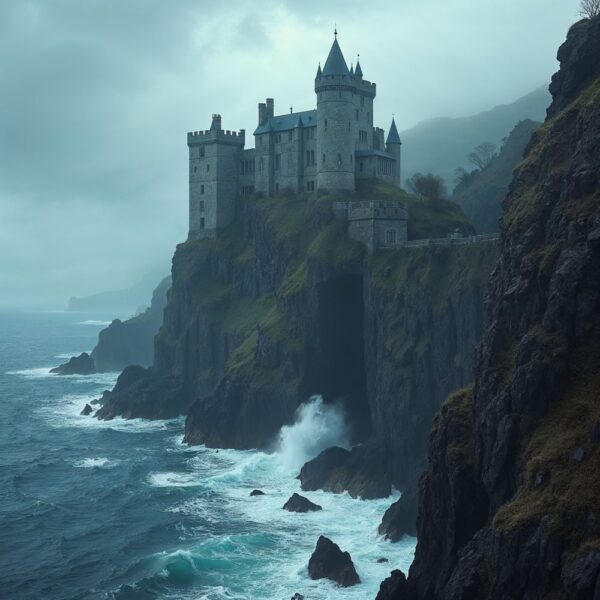
He stood beneath a chandelier,
dressed in black,
wearing the expression of someone
who had personally invented
the concept of a bad day.
His eyes found me.
And stayed.
“Do you know who I am?” he asked.
I looked him over.
The velvet. The jewels. The spectacular arrogance.
The general air of a man
who considered mercy a clerical error.
“Vlad,” I said. “The Third.
Bit of a reputation problem, I hear.”
His eyebrow twitched.
“You speak rather boldly
for someone standing before me.”
“Honey, I’ve stood before emperors,
plague doctors, executioners,
and three particularly dreadful poets.
You’re hardly my worst Tuesday.”
He laughed. Not pleasantly.
The sort of laugh that suggested
entire villages had once regretted
telling him a joke.
Then he noticed it.
The absence of years
upon my face.
The unchanging skin.
The eyes that had watched centuries
bury their own monuments.
“How old are you?”
“That’s an intimate question.”
“How long have you lived?”
“Long enough to know
that men who ask such questions
usually have something to compensate for.”
His mouth curved. “Oh, you are dangerous.”
He circled me,
studying the impossible mathematics
of my existence.
A woman who does not wither.
A woman who does not tremble.
A woman who has seen his century
come and go
without so much as a wrinkle
to show for it.
He had conquered kingdoms.
I had outlasted them.
He had made death
a public spectacle.
I had made a fool of time.
“Tell me,” he said,
his voice dropping into something
dangerously close to fascination,
“what is it that keeps you alive?”
“Excellent skincare.
And a deeply unreasonable
refusal to cooperate with mortality.”
He stared.
Then, quite unexpectedly,
he smiled.
“You amuse me.”
“I should hope so.
You look terribly difficult to entertain.”
His gaze darkened.
“I could have you impaled
for such insolence.”
“Could you?
How terribly ambitious of you.”
He leaned closer.
“Are you not afraid of me?”
“Vlad,” I whispered,
“I have watched men like you
rise to power,
mistake fear for devotion,
and disappear into history.
You are not the first monster
I’ve met.
You’re simply the best dressed.”
For the first time,
the Impaler had absolutely nothing to say.
For Vlad the third had spent his life
teaching the world to fear him.
But now he had encountered
a woman who could look him in the eye,
laugh at his threats,
and remain exactly as she was
when the centuries turned.
The Impaler wanted to know
the secret of my immortality.
I wanted to know
whether he always had this much trouble
with women who said no.
Neither of us
was prepared to surrender.
And somewhere in the castle,
I suspect,
a very old man
was beginning to discover
that eternity
could be considerably more troublesome
than death.
Photo credits: Pinterest
Posted for Open Link Night #420 (+LIVE) @dVerse Poets Pub

6 Responses
Oh my! What a tale you’ve told here. The dialogue approach is so very well done. I am most struck by these words:
“The spectacular arrogance.
The general air of a man
who considered mercy a clerical error.”
Mercy as a clerical error…..such a clever way to word an odious personality trait!
So very well writ — of course!
Thank you so much, Lillian 😀 so glad you enjoyed it! 💄❤️
I will be reading this one on Saturday! 😉
I love that you captured an event, an instance, in this poem, Sanaa, with characterisation through dialogue and humour, especially in the retort:
“Honey, I’ve stood before emperors,
plague doctors, executioners,
and three particularly dreadful poets.
You’re hardly my worst Tuesday.”
And these lines:
‘He had made death
a public spectacle.
I had made a fool of time.’
Thank you so much, Kim 😀 so glad the poem resonated with you 💄❤️
This dialogue is most excellent… Love how you find the worst monsters to tease and win over… a great series here.
Thank you so much, Bjorn 😀 it was fun to write this one, a new series. So glad you enjoyed it 💄❤️